

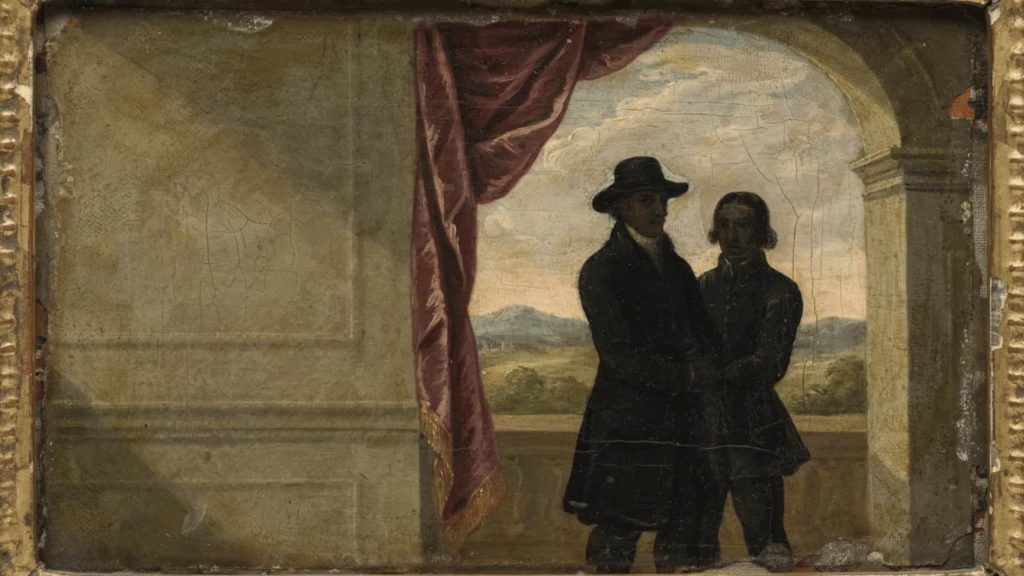
Who was the first gay person? The truth is that no one can answer that with certainty.
Sexual orientation existed long before written history, leaving no single name that can be confirmed as the first gay person in history.
Instead, historians rely on poetry, artwork, ancient tombs, personal letters, and legal records to trace evidence of same-sex relationships across different civilizations.
Some figures are supported by stronger historical evidence than others, while one individual later became the first to publicly identify as gay and speak openly about gay rights.
Who was the first gay person?
No one can name the first gay person in history, and that’s simply the limit of what evidence allows us to know for certain.
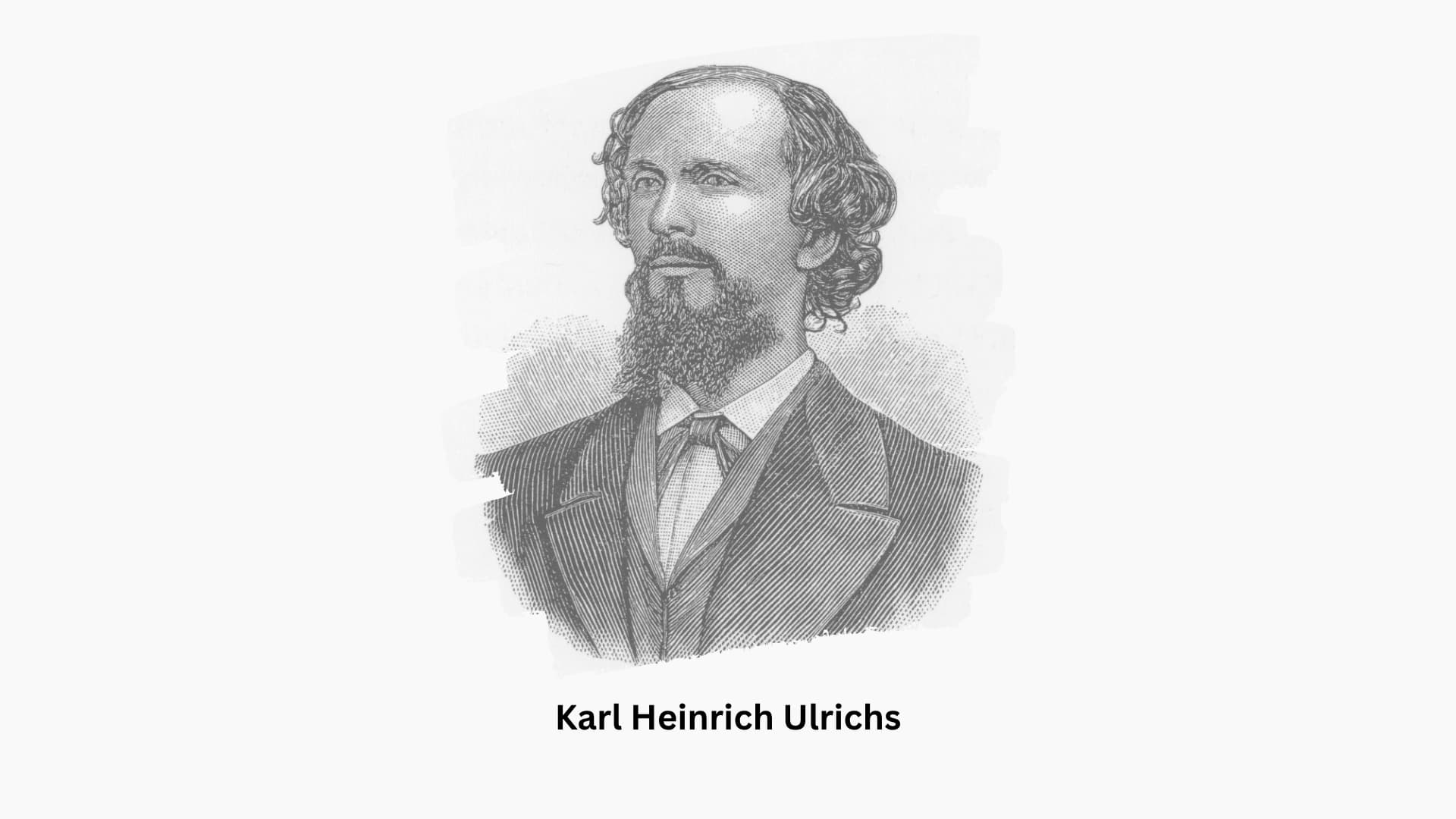
What can be documented is Karl Heinrich Ulrichs, recognized as the first person to publicly identify as gay and organize for legal rights in Germany in 1867.
Before that point, historians rely on indirect evidence: poetry, art, letters, and burial sites.
These sources point toward people who likely loved others of the same sex, even without using that specific word.
The earliest LGBTQ+ firsts in history
A few “firsts” get repeated constantly online, though they address entirely different questions, from personal identity to national policy change.
| Historical first | Name | Date | Why they’re recognized |
|---|---|---|---|
| First openly gay person | Karl Heinrich Ulrichs | 1860s | First documented public self-identification and advocacy |
| First modern gay rights activist | Karl Heinrich Ulrichs | 1867 | Public speech before the German Jurists’ Congress |
| Earliest suspected same-sex couple | Khnumhotep and Niankhkhnum | c. 2400 BCE | Shared tomb and intimate iconography |
| First known lesbian poet | Sappho | c. 600 BCE | Surviving lyric poetry about women |
| First LGBTQ+ rights organization | Scientific-Humanitarian Committee | 1897 | Founded by Magnus Hirschfeld |
| First country to legalize same-sex marriage | Netherlands | 2001 | Civil marriage equality nationwide |
Reading these first side by side, I found it clearer why one person, one couple, and one law rarely settle the same question.
Suspected LGBTQ+ figures throughout history
None of these figures can be labeled with modern certainty, but letters, art, and eyewitness accounts leave real patterns worth examining honestly.
1. Hadrian and Antinous
After Antinous drowned in the Nile in 130 CE, Hadrian deified him, founded Antinoöpolis, and commissioned hundreds of statues in his honor.
Ancient accounts in Cassius Dio’s Roman History and the Historia Augusta describe Antinous as Hadrian’s favorite.
2. Alexander and Hephaestion
King James I’s surviving letters to George Villiers contain unusually affectionate language, leading many historians to examine their relationship.
The surviving royal correspondence documents James calling Villiers his “sweet child and wife,” though interpretations differ.
3. James I and George Villiers
King James I’s surviving letters to George Villiers contain unusually affectionate language, leading many historians to examine their relationship.
The surviving royal correspondence documents James calling Villiers his “sweet child and wife,” though interpretations differ.
4. Sappho
The ancient Greek poet Sappho wrote verses expressing affection and desire for women.
Although much of her work is lost, her surviving poetry inspired the modern term lesbian, derived from her home island of Lesbos.
Her sexuality remains a subject of scholarly interpretation.
5. Michelangelo and Tommaso dei Cavalieri
Michelangelo dedicated deeply personal sonnets and presentation drawings to Tommaso dei Cavalieri.
Their emotional language has prompted centuries of scholarly debate, though historians disagree on whether the relationship was romantic, spiritual, or both.
6. Leonardo da Vinci
Leonardo was anonymously accused of sodomy in Florence in 1476, though the case was dismissed without conviction, according to Florentine court records.
His lifelong relationships with Salaì and Francesco Melzi have since been widely discussed by historians.
7. Khnumhotep and Niankhkhnum
Khnumhotep and Niankhkhnum shared a tomb at Saqqara around 2400 BCE and were depicted embracing in unusually intimate poses, as documented by the Egyptian Ministry of Tourism and Antiquities.
Whether they were brothers or partners remains an active scholarly debate.
How Karl Heinrich Ulrichs changed history
Ulrichs didn’t invent same-sex love, but I’d argue he did something rarer: he stood up and named it before anyone else dared to.
Same-sex relationships existed across cultures and centuries even before him. However, people rarely spoke publicly in their own defense.
Even so, no organized rights movement existed yet.
What Ulrichs did
- Publicly identified himself using the term Urning.
- Published essays defending same-sex attraction as natural.
- Argued for homosexual rights in an 1867 speech and was shouted down.
One must notice that he is remembered for even more; his writing inspired Magnus Hirschfeld directly. His framework shaped early LGBTQ+ activism across Europe. And he shifted the fight from secrecy to public argument.
That shift from silence to open argument is the real reason his name still surfaces in every serious history of gay rights.
Final thoughts
Every name in this piece, from Sappho to Hadrian to Ulrichs, shows how differently evidence looks depending on the century you’re reading.
Reading these sources side by side shows one thing plainly. The first gay person will never be identified, but the first openly gay person changed how everyone after him could speak.
I hope this timeline gave you a clearer sense of how historians actually build these cases, argument by argument, source by source.
If any of these figures caught your attention, I’d genuinely love to hear which one in the comments.
Frequently Asked Questions
How did 19th-century criminalization affect historical records?
Laws against sodomy across Europe pushed same-sex relationships into secrecy, making letters and diaries rarely state intentions plainly. Court records from prosecutions, ironically, became some of the clearest evidence, as accusations forced private lives into official records that might never have existed.
What became of Magnus Hirschfeld’s Institute for Sexual Science?
Hirschfeld founded the Institute for Sexual Science in Berlin in 1919, building on Ulrichs’s earlier arguments. Nazi forces destroyed it in 1933, burning its research library, a major loss to LGBTQ+ scholarship and clinical sexology.
How do historians avoid projecting modern identity labels onto historical figures?
Careful historians document behavior, relationships, and language instead of using fixed modern labels like gay or bisexual. They consider cultural context, reactions, and how the era would have understood the relationship, highlighting uncertainty rather than imposing modern labels on incomplete evidence.
Why do historians debate interpretations of ancient same-sex evidence so much?
Ancient sources rarely explain intentions directly, so historians work from tombs, poetry, and letters that support multiple readings. Cultural bias, translation choices, and gaps in surviving material all shape interpretation, which is why credible historians hold competing theories rather than declaring a single verdict as settled fact.