
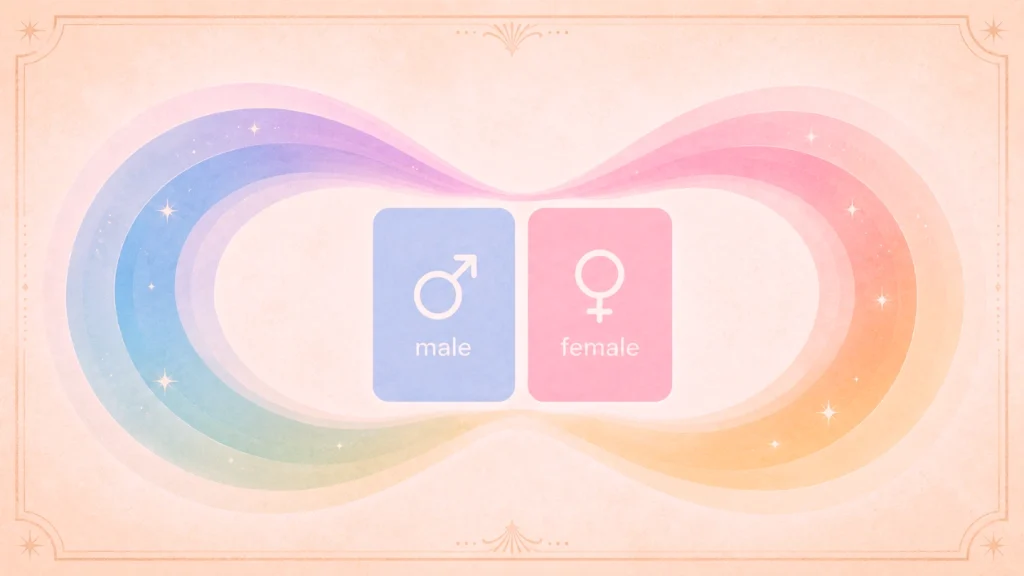
Beyond binary meaning is simple, but it is often explained in ways that make it seem harder than it is. It means gender is not limited to only male and female.
I know that it can feel unfamiliar if you were taught gender as two clear boxes. But unfamiliar does not mean unreal.
My goal is to explain gender identity in plain language, without making people’s lives sound like a debate topic. Some readers may be open. Some may be unsure. Either way, the starting point is accuracy.
What is beyond binary?
“Beyond binary” means looking past the idea that gender has only two fixed options: male and female.
The word binary means a system with two parts. In gender, the binary usually means:
- male or female
- man or woman
- masculine or feminine
- one side or the other
That model fits many people. Some people are men. Some people are women. Their gender feels clear, steady, and well described by those words. But not everyone fits that model.
What “beyond binary” points to is that some people –
- Do not experience gender as only male or female.
- Partly connected to one gender.
- Connected to more than one.
- Do not feel connected to gender at all.
- Their gender shifts over time.
Gender identity, gender expression, & sex assigned at birth
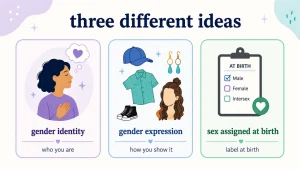
People often argue about gender because they mix up terms that mean different things. These three are related, but they are not the same.
Gender identity
Gender identity is a person’s inner sense of their gender. It is who someone knows themselves to be.
A person’s gender identity may be man, woman, nonbinary, agender, genderfluid, genderqueer, another term, or no fixed label.
Useful things to remember:
- Gender identity is not always visible. You cannot always know someone’s gender by looking at their body, clothes, or voice.
- Gender identity may match or may not match their birth assignment. A person assigned a gender at birth as male may grow up to either agree to the idea of being a male or not.
- Gender identity does not need outside approval. A person’s gender is not less real because someone else finds it confusing.
Gender expression
Gender expression is how someone presents themselves. It can include clothing, hair, voice, makeup, body language, and style.
This is where many people make quick and wrong guesses. A person can look masculine, feminine, both, neither, or change their style often. That does not automatically tell you their gender identity. For example:
- A nonbinary person does not have to look androgynous. There is no required appearance for living outside the gender binary.
- A masculine/feminine-looking person may not be a man/woman. Clothing and body language do not prove someone’s gender identity. Style can express taste, culture, safety, comfort, or mood.
- A person’s expression can change without their identity changing. Someone may dress differently at work, home, with family, and in public spaces.
Sex assigned at birth
Sex assigned at birth is the category someone was given when they were born. This is usually based on visible physical traits and is recorded as male or female in early records, but it does not tell you everything about who they are.
- Birth assignment is a record, not a full identity. It does not explain someone’s whole relationship with gender.
- Some people are intersex. Human bodies do not always fit typical male or female categories.
- Private details should stay private. Bodies, medical care, old names, and documents are not casual questions.
- Use the person’s current name and words. That is more respectful than digging for personal history.
How gender language moved beyond the binary
The idea did not become visible all at once. It gained momentum because people needed better words for what the gender binary kept leaving out.
Words like genderqueer became more visible in queer and activist spaces in the 1990s. The word carried resistance. It did not just describe gender outside the binary; it also challenged the rules that made the binary feel mandatory.
Later, nonbinary became more widely used as an umbrella term and personal identity. For many people, it gave clearer language for saying, “I am not only a man or only a woman.” Other words, like agender, genderfluid, bigender, and demigender, gave people more specific ways to explain their experience.
“Beyond binary” stands above those labels. It is the bigger idea: gender does not stop at two options. It is not one more box. It is the refusal to pretend that two boxes are enough for everyone.
How to talk to someone who lives beyond the binary
You do not need perfect words to be respectful. You need to listen, use the language they give you, and avoid treating their identity as a debate.
| What to say | What not to ask |
|---|---|
| “What name would you like me to use?” | “What are you really?” |
| “What pronouns should I use for you?” | “Were you born male or female?” |
| “Do you use those pronouns everywhere?” | “Have you had surgery?” |
| “Thanks for telling me.” | “Why do you need a label?” |
If you make a mistake, correct yourself briefly and continue. A long apology can make the other person manage your guilt. Respect is not about having every perfect sentence ready. It is about listening, adjusting, and doing better next time.
Famous people helped push the conversation into the open

Nonbinary identity did not start with celebrities, but famous people helped make the conversation harder to ignore.
Sam Smith publicly came out as nonbinary in 2019 and asked people to use they/them pronouns. That moment highlighted nonbinary identity in mainstream music, interviews, headlines, and daily debates.
Janelle Monáe has also spoken publicly about being nonbinary. Their words matter because they did not see gender as a neat box to escape. They spoke about seeing themselves beyond the binary, linking to this wider idea.
Demi Lovato came out as nonbinary in 2021 and shared they/them pronouns at the time. Their announcement made many consider how personal gender language can be, especially for someone still learning, changing, and explaining themselves publicly.
Bella Ramsey, known for The Last of Us, has also spoken about being nonbinary. Their visibility matters for a younger audience because it shows that this is not only a music-industry or activist-space conversation but part of everyday identity, even for famous people.
These public figures didn’t invent gender beyond the binary but made it harder to ignore. Visibility doesn’t solve everything, but it prompts a question: if people keep defining themselves, why are we more focused on arguing than listening?
Myths about gender beyond the binary
A lot of fear about gender comes from repeated myths. Some people hear the same false claims so often that they start to sound like facts.
| Myth | Reality |
|---|---|
| “Beyond binary means men and women do not exist.” | It means men and women are not the only gender possibilities. |
| “Nonbinary people are just confused.” | Many people know exactly who they are; others may lack the language. |
| “Everyone beyond the binary uses they/them pronouns.” | Pronouns vary. People may use they, she, he, or more than one. |
| “You can tell someone’s gender by looking.” | Appearance is gender expression, not proof of gender identity. |
| “This is just a new trend.” | The words may be newer, but gender diversity itself is not new. |
| “Respecting pronouns is too hard.” | Learning someone’s pronouns is a basic act of attention. |
| “Talking about this forces labels on people.” | Respectful language lets people name themselves or refuse labels. |
A person’s gender is not proven by whether someone else finds it familiar. Many people reject what they have never had to think about. That does not make the identity false. It means the listener may need better context.
Frequently asked questions
Can someone know they are beyond binary at a young age?
Yes. Some people understand their gender very early, while others need more time and language. Age does not make someone’s experience fake. It only affects how safely and clearly they can explain it.
Is “beyond binary” used as a personal label?
Sometimes, but not usually. Most people use terms like nonbinary, genderqueer, agender, or genderfluid for themselves. “Beyond binary” is more often used to explain the wider idea that gender is not limited to two options.
What if I do not understand someone’s gender?
You do not need to understand every detail to be respectful. Use the name and pronouns they give you, avoid private questions, and learn without making one person defend their whole identity.
Can language around gender change over time?
Yes. Language changes as people find better words for their lives. That does not mean the experience is new or fake. It means the words are catching up to what people have been living.
Conclusion
The beyond binary meaning is not that gender has no structure or that men and women do not matter. It means the traditional two-option structure does not describe everyone.
Some people live fully as men or women. Others do not, and their reality is not less serious because it is less familiar to someone else. I care about this language because it can make people feel seen instead of argued with.
My hope is that readers leave with more accuracy, more care, and fewer assumptions about gender identity.