

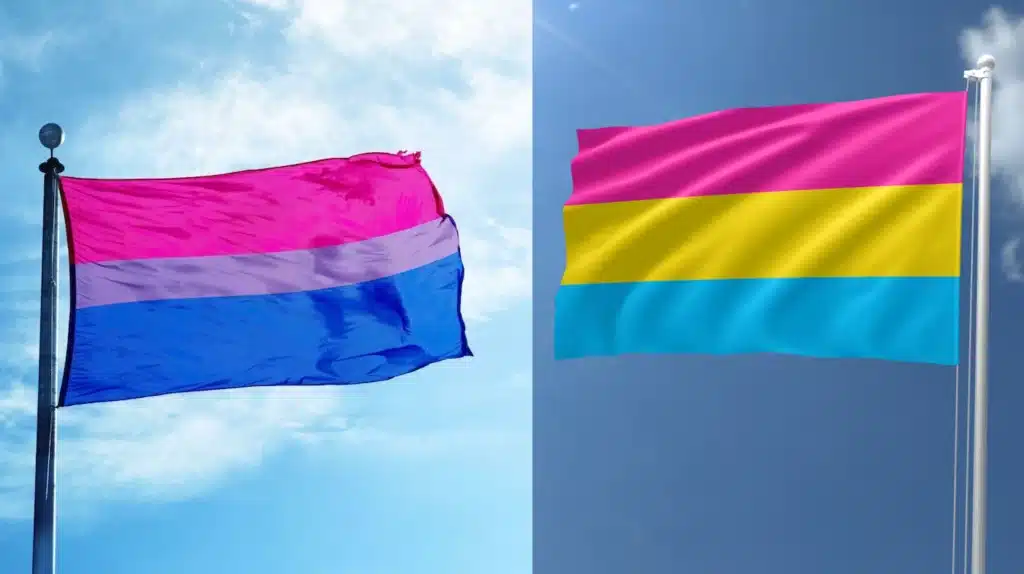
Pansexual and bisexual get mixed up constantly, and it’s easy to see why.
The two overlap so much that even people inside the LGBTQ+ community sometimes use them loosely.
I’ve spent enough time following how identity language shifts to know that these definitions aren’t static. They move as the people using them refine how they describe their own experience.
Here’s how pansexual vs bisexual differ.
You’ll get both definitions, a side-by-side comparison, the misconceptions keeping this debate alive, and why the label someone picks isn’t up for outside debate.
What is pansexual?
Pansexual meaning: attraction that isn’t organized around gender at all. A pansexual person can be drawn to anyone, man, woman, nonbinary, or otherwise, without gender acting as the filter.
Gender isn’t invisible here; it just isn’t the deciding factor. Personality and chemistry usually carry more weight.
Experiences vary. Some pansexual people never framed attraction around gender to begin with. Others noticed it, then realized it didn’t change how they felt.
Pansexuality describes how someone experiences attraction, not who they’ve dated. That’s easier to picture once you look at how attraction actually unfolds for someone who identifies this way.
I’ve found these definitions get shaped more by the people living them than by any dictionary entry.
What is bisexual?
Bisexual means attraction to more than one gender.
That’s the modern, widely accepted definition, broader than what a lot of people still assume.
The old shorthand of “attracted to men and women only” is outdated. It leaves out nonbinary people, whose experience often falls outside typical gender categories, and treats gender as strictly two options, which doesn’t match how most bisexual people describe their own attraction.
Attraction also doesn’t have to be equal across genders. Someone might feel drawn to men and women differently, or notice attraction to one gender more often. That doesn’t make the label less accurate.
Bisexuality also carries decades of history as an organized identity and movement.
Pansexual vs Bisexual

Pansexual and bisexual aren’t opposites, and they aren’t competing for the same spot on a spectrum. The easiest way to see how they relate is to look at a few specific points side by side.
How attraction works
- Pansexual: attraction isn’t organized around gender at all. Someone’s gender identity simply isn’t part of the equation for a pansexual person.
- Bisexual: attraction is directed toward more than one gender. Gender is still part of the picture, it just isn’t limited to one.
How much does gender factor in
- Pansexual: gender tends to sit in the background. A pansexual person might say they’re drawn to someone’s personality or energy well before gender enters the picture.
- Bisexual: gender can matter more, less, or differently from one person to the next. Some bisexual people notice patterns in who they’re drawn to. Others don’t.
Visibility and history
- Pansexual: gained wider recognition more recently, largely as language around gender identity expanded and more people found it fit their experience.
- Bisexual: carries a longer history as both a personal identity and an organized movement, with decades of activism behind it.
Where the two overlap
- Pansexual: many pansexual people would also feel accurately described as bisexual, since attraction to multiple genders is part of both.
- Bisexual: many bisexual people find pansexual fits just as well, depending on how central gender feels to their own experience.
These definitions overlap more than they conflict. Two people with nearly identical experiences of attraction might land on different labels simply because one word feels like a truer reflection of how they see themselves.
Where the confusion actually comes from
A lot of the tension between these two labels comes down to a handful of persistent myths.
| Misconception | Reality |
|---|---|
| Bisexual means only two genders | Outdated reading. The modern definition covers attraction to more than one gender, without limiting the count to two or naming which ones. |
| Pansexual is more inclusive than bisexual | Both cover attraction beyond a single gender. Ranking one as more open-minded turns two valid identities into a competition that doesn’t need to exist. |
| Pansexual people are attracted to everyone | This confuses attraction with compatibility. Gender doesn’t limit who a pansexual person could be attracted to, but personality and chemistry still decide who they actually are. |
| Someone can’t identify as both | Plenty of people do. Others try both and settle on the one that fits better. Neither approach is more correct. |
How these identities have evolved
- Early bisexuality: named and organized fairly early, but understood through a narrow lens focused only on men and women.
- LGBTQ+ activism: pushed definitions to expand, making room for nonbinary and gender-diverse experiences instead of assuming only two genders existed. That same expansion is why shifting versus fixed identities eventually needed separate names.
- Pansexuality’s rise: gained visibility as that broader understanding of gender took hold, giving people a word for attraction that was never centered on gender categories to begin with.
- Ongoing change: language keeps moving because the people using it keep refining how they describe their own experience, not because of any passing trend.
Respect starts with self-identification
However someone describes their own attraction, that’s the label worth using.
Guessing at a “more accurate” term based on outside assumptions isn’t helpful, even when it’s well-meant.
Someone’s current relationship doesn’t reveal or confirm their identity. A bisexual person dating someone of a different gender isn’t suddenly straight, and a pansexual person in a long relationship hasn’t stopped being pansexual.
Language will keep shifting. Staying open to hearing new terms or updated meanings of familiar ones matters more than memorizing a perfect definition and holding on to it forever.
Respect looks like using the word someone gives you, without turning it into a debate about which one is “right.”
Conclusion
Pansexual vs bisexual isn’t a contest with a winner.
Both describe real, valid ways of experiencing attraction, and the overlap between them is often bigger than the differences.
Once the pansexual meaning and bisexual meaning are actually understood, the two stop looking like rivals and start looking like two honest ways of naming a similar experience.
If this cleared things up, there’s more to unpack across the LGBTQ+ vocabulary.
Feel free to drop a question in the comments; respectful curiosity is always welcome here.
Frequently asked questions
1. Is pansexual a type of bisexual?
Not exactly. The two are separate identities that overlap heavily, since both describe attraction to more than one gender. Neither one is a subcategory of the other.
2. Is one identity newer than the other?
Pansexuality became widely recognized more recently. Bisexuality has a longer history as a named identity and movement.
3. Does being pansexual mean gender doesn’t matter at all?
It means gender isn’t the deciding factor in attraction. It doesn’t mean gender is invisible or irrelevant to a pansexual person.
4. How do I know which label fits me?
There’s no test for it. Most people land on the word that best matches how they actually experience attraction, and that can take time to figure out.