


Most people throw around the words kink and fetish like they mean the same thing, and honestly, that is fine for casual conversation.
But if you have ever been mid-moment with someone and genuinely not known what they meant when they said one of those words, or if something has come up between you and a partner that left you a little unsure, that confusion is worth clearing up.
From my years of reading and writing about sexual health, the simplest way to put it is this: a kink is something that turns you on and makes things feel hotter, something you love having in the mix.
A fetish runs a little deeper than that, something that feels less optional and more essential to how your body responds. Neither one is something to be embarrassed about. Neither one says anything bad about you.
The clinical understanding of kink and fetish
Both kinks and fetishes fall under what researchers call paraphilic interests, which is just a clinical way of saying sexual interests that sit outside what most people consider the default. Both can be completely healthy and completely normal.
The thing that separates a desire from a disorder is not the desire itself. It is whether it causes real distress, gets in the way of your life, or involves someone who has not consented.
The DSM-5, which is the main reference manual used by mental health professionals, is actually very clear about this: an unusual sexual interest is just an interest. It only becomes a clinical concern when it starts causing real harm or real pain.
So kink means something you enjoy, and fetish means something more central to your arousal, both of which live well within the range of normal human sexuality.
If you want the short version, here it is:
Kink: Something that adds real heat to sex. You want it in the mix, but you can still have a great time without it.
Fetish: Something that sits deeper than a want. It is closer to a need, and sex without it tends to feel like something is genuinely missing.
The easiest way to tell the difference: If you took it completely off the table, could you still feel fully turned on and satisfied? If yes, it is probably a kink. If that sounds genuinely difficult, it is probably closer to a fetish.
Kink vs fetish: Meaning, examples, and key differences

Like every intimate activity involving another person, kinks work best when there is open communication, clear boundaries, and enthusiastic consent from everyone involved.
The same principles apply to fetishes. Honest conversations, mutual comfort, and respect for personal limits are essential parts of any healthy intimate connection.
1. Role in arousal
Kink: A kink adds another layer to attraction and intimacy. It can heighten excitement, deepen connection, or create a stronger emotional charge, but it is usually not the foundation of arousal itself.
Fetish: A fetish often sits much closer to the center of arousal. The object, material, body part, or scenario may become one of the primary triggers that fuel desire and sexual interest.
2. Fantasy vs reality
Kink: Many kinks exist comfortably as fantasies. Someone may enjoy imagining a certain dynamic or scenario without ever wanting to bring it into real life.
Fetish: A fetish can exist in fantasy as well, but the specific focus often remains important whether it appears in imagination, visual content, or real-world intimacy.
3. Flexibility and frequency
Kink: Kinks tend to be flexible. Someone may enjoy them one night and have no interest in them the next. They often change, grow, or evolve over time and across relationships.
Fetish: Fetishes are usually more consistent. The attraction often remains focused on the same object, body part, material, or theme, sometimes for many years.
4. Examples of kink and fetish
Kink: Roleplay, consensual power exchange, light bondage, sensory play, dirty talk, or specific scenarios are common examples of kinks. They create tension, anticipation, and excitement, but intimacy can still feel fulfilling without them.
Fetish: Feet, leather, latex, particular footwear, specific fabrics, scents, or certain body parts are common examples of fetishes.
Pleasure devices are also common in sensory play, and knowing how a rose toy works is useful foranyone exploring suction-based stimulation. These elements often become a major focus of attraction and may carry much more weight in the person’s arousal process.
5. What makes a kink or fetish a concern?
Kink: A kink is not a problem simply because it is uncommon. Concerns arise only if it creates distress, causes harm, or ignores another person’s boundaries.
Fetish: A fetish is not automatically unhealthy either. It becomes a concern only when it leads to significant distress, affects daily life, creates relationship difficulties, or involves situations where consent is absent.
Where kinks and fetishes overlap
The line between a kink and a fetish can blur fast. The same interest may feel playful for one person and deeply tied to arousal for someone else. Here are some overlap examples:
| Interest | Kink Example | Fetish Example |
| Feet | Someone enjoys foot massages, kissing, or extra attention to their partner’s feet sometimes, but sex still feels complete without it. | Feet become the main focus of desire, and intimacy feels flat or incomplete without foot-related attention, touch, or imagery. |
| Restraints | A couple uses handcuffs, rope, or soft restraints now and then because the tension and trust feel exciting. | Restraints feel central to arousal, and sex feels far less intense when that bound-up feeling is missing. |
| Leather or Latex | Seeing a partner in leather or latex adds heat and confidence to the moment, but attraction exists without it. | The material itself becomes a major source of arousal, and desire often centers on seeing, touching, or imagining it. |
| Power Exchange | Someone sometimes enjoys taking a dominant or submissive role because it changes the mood and adds intensity. | The power dynamic becomes a core part of desire, making intimacy feel incomplete without that structure. |
| Specific Clothing | A certain outfit creates mood, mystery, or tension during a particular encounter. | The clothing itself becomes one of the main sources of attraction and carries much more sexual weight. |
The object or activity is only part of the story. What really matters is how much power it holds in the person’s desire, arousal, and satisfaction.
Kinks, fetishes, and historical figures
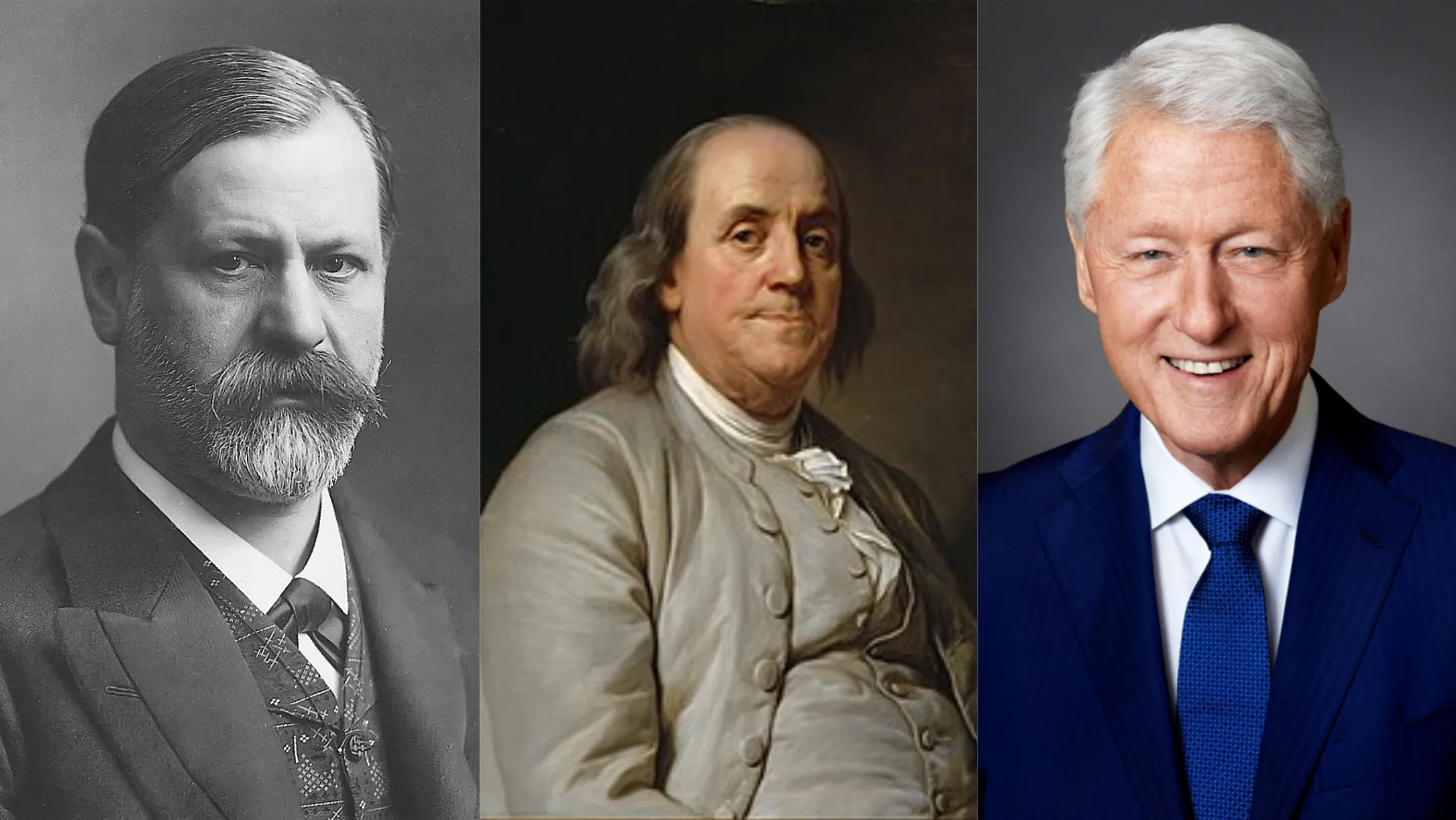
Kinks and fetishes are not a modern invention. History’s most powerful figures carried their own desires quietly, and sometimes not so quietly, long before clinical language ever existed to name them.
1. Sigmund Freud and the clinical language of desire
Sigmund Freud, the Austrian neurologist who essentially built the foundations of modern psychoanalysis, gave the field much of its earliest vocabulary around sexuality.
His 1905 work Three Essays on the Theory of Sexuality included some of the first clinical writing on fetishism, framing it as a kind of psychological substitution. Later research moved well beyond that framing, but Freud remains the figure who first made it acceptable to talk about these things in a clinical setting at all.
2. Benjamin Franklin’s well-documented desires
Benjamin Franklin is probably the most candid Founding Father on record about his own sexual preferences. In his 1745 letter “Advice on the Choice of a Mistress,” he laid out, point by point, his strong preference for older women as lovers.
Historians have documented his known illegitimate children and his reputation as a libertine among the Founding Fathers. His openness about desire, notably, made him a far more effective diplomat in France.
3. Bill Clinton and the Oval Office
Bill Clinton, the 42nd President of the United States, became one of the most publicly scrutinized leaders in American history for his sexual behavior in the White House.
The Monica Lewinsky scandal, involving intimate encounters within the Oval Office itself, led to his impeachment on charges of perjury. Whatever one thinks of the circumstances, it remains one of the most documented cases of a sitting president’s sexual conduct becoming part of the public and legal record.
America has one of the richest documented histories of powerful figures with very human desires. Kinks and fetishes do not skip the powerful. If anything, history suggests they never did.
Comparing kink, fetish, preference, and fantasy
These words can feel tangled because they all sit close to desire. The difference comes down to intensity, flexibility, and whether the thought stays private or becomes part of real intimacy:
| Term | What It Means | Simple Example |
| Preference | A flexible “I like this better” feeling. It is easy, low-pressure, and not deeply tied to arousal. | You like morning sex more than late-night sex. |
| Kink | A charged interest, activity, or dynamic that adds heat, tension, or intensity to sex. | You like power play, restraint, sensory play, or being told what to do in bed. |
| Fantasy | A desire or scenario that lives in your mind. It may stay private or become something you discuss with a partner. | You imagine a certain scene but may never want to act it out. |
| Fetish | A stronger, more central focus that may feel closely tied to arousal or sexual satisfaction. | You need a specific outfit, fabric, body part, or object to feel fully turned on. |
Use these labels as guides, not cages. What matters most is knowing what you want, what you need, what stays in your head, and what requires consent.
How common are kinks and fetishes?
More common than you might think, and more common than the silence around these topics would ever lead you to believe.
This data does not mean everyone has a kink or fetish. It means these interests are a genuinely normal part of the human sexual landscape, not a niche or fringe thing. The research also consistently shows that many people carry a fantasy or desire throughout their lives and never feel the need to act on it. That is valid too.
The 2016 Joyal and Carpentier study found that nearly half of the people surveyed reported interest in at least one atypical sexual behavior.
A 2020 study across over 10,000 adults in the Czech Republic found that around 31% of men and 14% of women reported at least one paraphilic preference, with foot fetishes, voyeuristic interests, and masochism among the most common.
A 2024 Swiss study of adults aged 18 to 50 put the figure at over 46%. Common does not mean shared. You do not have to like or try a partner’s kink or fetish. Respect goes both ways: honor the desire and the limit. Shame makes these talks harder, while honest language, clear boundaries, and listening without judgment make them safer.
How to bring up a kink or fetish with a partner

Talking about a kink or fetish feels intimidating for many people, but it rarely needs a dramatic setup. Clear words, mutual respect, and honest communication usually make these conversations much easier.
- Start gently: “Can I share something on my mind?” leaves space for honest discussion.
- Share fantasies without expectations, making it clear your partner can comfortably decline participation.
- Explain interests clearly rather than using vague labels that invite misunderstanding.
- Describe what appeals to you and why it feels exciting, intriguing, or emotionally meaningful.
- Try a yes-no-maybe list to identify overlap without creating unnecessary pressure.
- Compare responses together and focus on shared interests rather than mismatched desires.
- Respect every answer, including uncertainty, hesitation, or a direct no without argument.
- Consider professional guidance if desire creates distress, relationship strain, or recurring confusion.
- Seek a kink-aware therapist who understands consensual interests without treating them as problems.
- Choose qualified professionals who focus on communication, boundaries, relationship dynamics, and personal wellbeing.
The strongest conversations are rarely the most dramatic ones. They are honest, specific, and respectful, giving both people room to express desire, set limits, and feel genuinely heard. Acting on shared interests also means thinking practically, and exploring places to have sex together can be a low-pressure way to turn an honest conversation into something you both actually enjoy.
Common myths about kinks and fetishes
Myths make kinks and fetishes sound scarier than they are. The truth is usually simpler, calmer, and more human: desire needs consent, care, and clear limits. Here are some common myths:
| Myth | Truth |
| Having a kink means something is wrong with you. | A kink is a sexual interest, not a diagnosis. Consent, safety, and comfort matter far more than how common it is. |
| A fetish is always extreme or shocking. | A fetish can focus on something simple, like a fabric, scent, object, or body part. Its role in arousal matters most. |
| Partners must take part in each other’s kinks or fetishes. | No one owes participation in anything that feels wrong for them. Desire deserves respect, and limits deserve the same. |
| Kinks and fetishes never change. | Some stay steady for years. Others shift with age, confidence, experience, or relationships. Both patterns are normal. |
| Sex without a fetish is impossible. | This varies. Some people can enjoy sex without it, while others find arousal harder. Neither automatically means there is a problem. |
When you strip away the myths, the real question becomes simple: is it consensual, respectful, safe, and not causing harm? If yes, shame does not need the final word.
Consent is where the line actually is
Consent matters more than any label. It keeps desire honest, safe, and mutual. A kink or fetish only belongs in real intimacy when everyone involved freely agrees:
- Before: Ask what feels good, what is off-limits, and whether the idea should stay a fantasy for now.
- During: Check in clearly. Ask whether to keep going, slow down, or stop. Use a safe word or signal if needed.
- After: Talk about how it felt. Reconnect, offer comfort, and make space for care after anything intense.
- Always: Consent can change. A yes once is not a yes forever, so check in each time with real attention.
The real line is not kink versus fetish. It is consent versus pressure. When desire, limits, and care are all respected, intimacy has a stronger foundation.
Quick self-check: Kink, fetish, fantasy, or preference?
If you are trying to work out where your own interests sit, these questions can help you get clearer:
- Do you enjoy this, or does it feel like you genuinely need it?
- Can you feel fully turned on and satisfied without it?
- Is it something you imagine but never feel the pull to act on?
- Would another person need to be involved, and would they need to consent?
- Does it cause you any real distress or get in the way of your relationships?
- Could you describe it to a partner without feeling like something was fundamentally wrong about you?
Here is what the answers tend to point toward:
- You enjoy it and can take it or leave it: kink or preference
- You think about it but have no need to act on it: fantasy
- It feels genuinely hard to do without: fetish
- It is causing real distress, harm, or consent concerns: worth talking to a professional about
Frequently asked questions
Is it possible to have a fetish and never act on it?
Yes. A fetish can stay private as fantasy. It requires consent only when another person is involved. You never have to act on every desire.
What if a partner’s fetish does not appeal to me?
You can say no clearly and kindly. You are not required to join anything that feels wrong. The next step is an honest conversation about compatibility.
Is BDSM a kink or a fetish?
BDSM is usually a broad kink category. Specific parts may function like a fetish for some people, depending on how central they feel.
Do kinks and fetishes affect how satisfying a relationship is?
Research suggests kink and BDSM do not harm satisfaction by default. Many people report equal or higher satisfaction when communication, consent, and mutual respect are strong.
Summing Up
A kink is something that makes sex feel hotter, more charged, more yours. A fetish is something that sits at the center of how arousal actually works for you. Both are real, both matter, and the label is honestly the least interesting part.
From what I have learned so far about sexual health and pleasure, the thing that changes everything is not what the desire is. It is whether you feel safe enough to say it out loud to the right person.
Silence is where things get messy. Honesty, a little softness, and a partner who makes you feel genuinely safe are where things get really good. If you are still working out what you want, take your time.
That part is always worth getting right. Drop a comment below and let me know if you have dwelled in any of your kinks.





2 Responses